
Neuroplasticity enables your brain to reorganize by forming new neural connections in response to learning and experiences, underpinning habit formation and change. Repeated behaviors strengthen specific pathways, especially within the basal ganglia, consolidating habits over time. Disrupting cues or rewards can weaken these pathways, facilitating change. Your environment, mindset, and motivation influence this process, supporting lasting shifts. Exploring these mechanisms reveals how targeted strategies harness brain adaptability—if you look further, you’ll uncover ways to optimize your behavioral transformations.
Key Takeaways
- Neuroplasticity enables the brain to rewire and form new neural connections through experiences, learning, and environmental influences.
- Repeated behaviors strengthen specific neural pathways via synaptic plasticity, making habits more automatic over time.
- Disrupting cues or rewards in the habit loop weakens neural circuits, facilitating habit change and breaking unwanted behaviors.
- Engaging in physical, mental, and social activities promotes neurogenesis and supports the rewiring necessary for lasting change.
- A growth mindset and consistent practice leverage neuroplasticity principles to reinforce new, healthier habits and behaviors.
Understanding Neuroplasticity and Its Role in Brain Adaptation
Understanding neuroplasticity is essential to grasp how your brain adapts throughout your life. Neuroplasticity refers to the brain’s ability to reorganize itself by forming new neural connections in response to experiences and learning. This process involves structural changes, such as dendritic growth and synaptic remodeling, which support brain adaptation by modifying existing neural circuits and establishing new neural pathways. Neural activity drives these changes through mechanisms like long-term potentiation, strengthening specific connections to enhance functional capacity. Both structural and functional neuroplasticity occur across diverse brain regions, including the hippocampus and motor cortex, facilitating diverse adaptations. Factors such as learning, environmental stimulation, and physical activity stimulate neuroplasticity, promoting cognitive resilience and recovery. By understanding how neuroplasticity influences neural circuits, you gain insight into the brain’s dynamic capacity for change, which underpins your ability to learn new skills, recover from injuries, and adapt to new environments throughout your life.
How Habits Are Formed and Reinforced in the Brain
Have you ever wondered how repeated behaviors become automatic? Habit formation involves strengthening neural connections within brain circuits, particularly in the basal ganglia. Repeated behaviors induce synaptic plasticity, leading to long-term potentiation that solidifies neural pathways associated with the habit. This process transforms conscious actions, initially managed by the prefrontal cortex, into automatic responses managed by the basal ganglia. The habit loop—comprising cue, response, and reward—reinforces these neural pathways, further entrenching the behavior. As repetition continues, brain reinforcement shifts control from the prefrontal cortex to the more efficient basal ganglia, optimizing habit execution. The duration of habit formation varies notably, ranging from 18 to 254 days, depending on consistency. Key elements in this process include the strengthening of neural connections, neuroplasticity, and the development of dedicated brain circuits that facilitate automatic behavior through reinforced neural pathways.
The Habit Loop: Cues, Cravings, Responses, and Rewards
The habit loop comprises four interconnected components—cue, craving, response, and reward—that function collectively to reinforce habitual behaviors. Cues activate neural pathways signaling the need for a reward, prompting an automatic response driven by conditioned neural connections. This response produces a reward, often involving dopamine release, which reinforces the neural pathways involved. Over time, repeated cycles strengthen basal ganglia circuits, automating habits and making them resilient against change.
| Component | Function |
|---|---|
| Cue | Triggers neural pathways, signaling a need for a reward |
| Craving | Creates desire, driven by dopamine, to seek the reward |
| Response | Executes an automatic behavior based on cues and cravings |
| Reward | Activates dopamine pathways, reinforcing neural connections |
Disrupting any component—like changing cues or rewards—can weaken neural pathways, facilitating habit change and the formation of healthier patterns.
Strategies to Initiate and Sustain Positive Habit Change
Implementing effective strategies to initiate and sustain positive habit change involves a combination of deliberate planning and ongoing self-monitoring. Neuroplasticity facilitates this process by strengthening neural pathways associated with desired behaviors and weakening those linked to old habits. To optimize brain development, focus on manageable goals, such as brief meditation sessions, which reinforce neural connections without overwhelming your system. Replacing negative habits with healthier substitutes diminishes resistance and promotes durable neural rewiring. Additionally, habit stacking leverages existing neural pathways, enabling easier integration of new behaviors into routines. Regular reflection and journaling enhance self-awareness, allowing you to identify triggers and refine behavior modification strategies. Consistency, patience, and leveraging neuroplasticity principles are vital for long-term habit change.
- Use habit stacking to build on existing neural pathways
- Set small, achievable goals to reinforce neural connections
- Replace undesirable habits with healthier substitutes
- Reflect regularly to strengthen self-awareness
The Impact of Environment, Motivation, and Mindset on Habit Formation
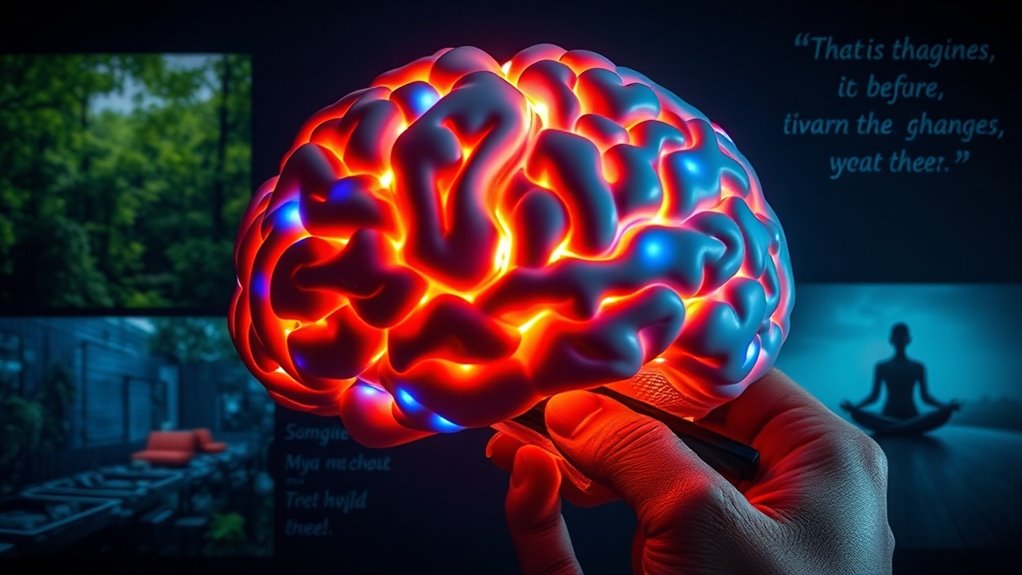
Environmental factors, motivation levels, and mindset considerably influence the neural processes underlying habit formation. These elements modulate neuroplasticity by shaping neural connections and reinforcing specific neural pathways essential for establishing new behaviors. An environment that presents clear cues, such as visible journals or healthy snacks, activates related neural pathways, facilitating habit formation. Altering surroundings to remove triggers and introduce positive stimuli simplifies this process, reducing reliance on willpower. Immediate reinforcement, like feeling energized after a healthy choice, amplifies motivation and strengthens neural associations, promoting durable habits. A growth mindset—believing that habits can change through effort—enhances persistence and resilience, encouraging continued engagement with desired behaviors. Personal motivation, driven by well-defined goals and positive self-talk, influences the strength and longevity of neural pathways involved in habit development. Collectively, these factors optimize neural connections, leveraging neuroplasticity to support sustainable habit change.
The Five-Step Process for Creating Lasting Behavioral Shifts
Achieving lasting behavioral change requires a systematic approach that guides you through intentional steps designed to rewire neural pathways. This five-step process—Discover, Diagnose, Prescribe, Practice, and Pause—facilitates neuroplasticity-driven habit change by targeting brain connections involved in behavior.
- Discover helps you identify your motivation, reinforcing learning new habits and strengthening neural rewiring.
- Diagnose uncovers friction points that impede progress, allowing you to remove obstacles and optimize neural pathways.
- Prescribe develops a tailored, manageable plan focusing on small, flexible steps to support habit formation.
- Practice consolidates behavioral shifts through consistent effort, reflection, and adjustment, reinforcing brain connections over time.
This structured process accelerates neural rewiring and fosters sustainable behavioral shifts, ensuring that new habits become ingrained through deliberate, science-backed habit change techniques.
Leveraging Neuroplasticity to Support Cognitive Fitness Throughout Life
Since the brain remains capable of reorganization throughout life, leveraging neuroplasticity offers a powerful approach to maintaining and enhancing cognitive fitness across all ages. By engaging in diverse mental, physical, and social activities, you stimulate neuroplasticity, fostering the formation of new neural connections essential for brain health. Regular physical exercise elevates levels of brain-derived neurotrophic factor (BDNF), supporting neural growth and resilience, crucial for habit change and cognitive adaptation. Incorporating learning new skills, maintaining social interactions, and managing stress further optimize neuroplasticity, enabling ongoing cognitive improvements.
| Activity Type | Neuroplasticity Impact | Cognitive Benefits |
|---|---|---|
| Physical Exercise | Increases BDNF, promotes neural growth | Enhances memory, executive function |
| Mental Engagement | Strengthens neural connections | Improves problem-solving, creativity |
| Social Interaction | Stimulates diverse neural pathways | Supports emotional regulation |
| Stress Management | Reduces cortisol, supports plasticity | Maintains focus, mental clarity |
Common Questions
How Long Does It Take to Rewire a New Habit in the Brain?
Rewiring a new habit typically takes about 21 to 66 days, depending on factors like repetition effects and individual neural pathways. During this learning process, your brain undergoes synaptic plasticity, strengthening neural connections through consistent practice. Habit formation involves brain rewiring as behaviors become automatic via neural pathway modification. The duration varies but is influenced by the frequency and intensity of behavioral change efforts, making persistent repetition essential for lasting change.
Can Neuroplasticity Help Recover From Brain Injuries or Trauma?
Neuroplasticity therapy markedly aids recovery from brain injuries or trauma by promoting neural rewiring and functional reorganization. Your brain’s ability for cognitive restructuring enhances neural resilience, supporting trauma rehabilitation. This process facilitates neural pathway strengthening and adaptive changes, making recovery more effective. While individual outcomes vary, understanding neuroplasticity’s role can empower you to pursue targeted treatments, maximizing brain injury recovery and improving long-term resilience after trauma.
Are Some Habits Easier to Change Than Others Due to Brain Structure?
Some habits are easier to change due to brain structure, as your brain’s structural differences influence neural circuitry and flexibility. Habits reinforced by emotional reinforcement tend to resist change because of ingrained neural pathways, whereas those involving cognitive adaptability are more susceptible to modification. Brain flexibility varies across individuals, affecting how easily neural pathways can be reconfigured. Ultimately, structural differences and neural circuitry determine habit resistance and the ease of change.
What Role Do Emotions Play in Reinforcing or Disrupting Habits?
Emotions profoundly influence habit formation, acting as both reinforcement and disruption. Emotional triggers activate the reward system, strengthening habits, while poor mood regulation can undermine motivation and increase stress responses, disrupting routines. Anxiety management and emotional resilience help maintain stability, enhancing motivation and supporting positive habits. Conversely, heightened stress and negative emotions can weaken habit pathways, making change more difficult, underscoring the critical role emotions play in shaping behavior patterns.
How Does Aging Affect the Brain’s Ability to Form New Habits?
As you age, your brain’s flexibility diminishes due to age-related changes, leading to reduced learning capacity. Cognitive decline impacts the formation of new neural pathways and weakens synaptic strength, making habit formation more challenging. Memory retention also decreases, hindering the reinforcement of new behaviors. While neuroplasticity persists throughout life, these factors collectively slow the brain’s ability to adapt and establish new habits effectively.
To Sum it up
By understanding neuroplasticity, you can effectively rewire your brain to establish lasting habits. While some argue that the brain’s adaptability diminishes with age, research indicates neuroplasticity persists throughout life, enabling continuous change. Applying targeted strategies—like manipulating cues and reinforcement—leverages this capacity. Ultimately, your ability to adapt hinges on consistent effort and mindset. Embracing this scientific insight, you can proactively shape cognitive patterns, demonstrating that habit change isn’t just possible—it’s rooted in the brain’s inherent plasticity.